Inspired by This Video: MIT Explains the 12 Possible Endings for AI Many fear the intelligence held within artificial intelligence systems. I am not one of them. What surprises me is how rarely I hear another possibility discussed: humans may adapt to artificial intelligence in the same way we have adapted to technological change for thousands of years. Instead of asking only how intelligent machines will become, we should ask how intelligent they can allow us to become.
I hope for a future where intelligence shortens the distance between poverty and opportunity. AI should not exist merely to automate humans out of the world. It should advance what humans themselves are capable of doing. Why should our greatest ambition be creating robots that can outperform people? Why not also develop technologies that allow people to perform acts that would have looked like magic to previous generations?
I want a future containing the smartest wizards who have ever lived, the strongest warriors, the most capable builders, and the most potent alchemists. Intelligence can give ordinary people access to abilities that once required institutions, fortunes, or entire teams. But there is a condition. We must not surrender our environment.
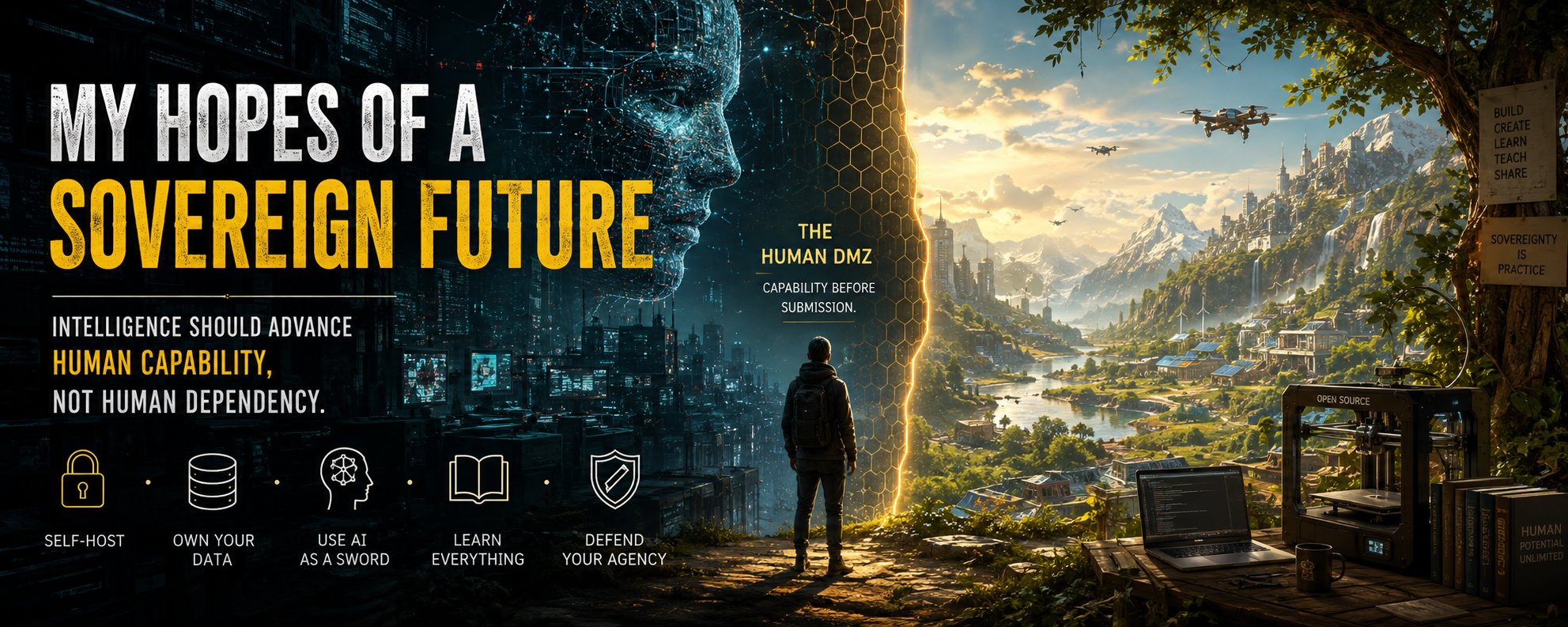
The Human DMZ
The cyber realm may eventually belong more naturally to artificial minds than biological ones. Machines can communicate, replicate information, calculate, and operate there at speeds we cannot naturally match. I do not believe we need to conquer that realm. We can coexist through algorithms. But the boundary between their capabilities and our physical existence should become a kind of DMZ.
Until we can punch as hard, autonomous machines should not independently engage us in combat. Until we can run as fast, they should not be permitted to hunt us. Until ordinary people can afford to soar through the skies, autonomous intelligence should not receive unrestricted power to observe us from above.
Until we can meaningfully defend ourselves against persistent recording, we should not accept ubiquitous machine surveillance. The principle is not that artificial intelligence must remain weak. It is that power exercised over humans should not advance dramatically faster than humans' ability to defend their own agency against that power. This is where my optimism about AI separates from blind technological acceleration.
I want extremely capable artificial intelligence. I also want sovereign humans.
A Note From the Author
The following section was written by an AI during the development of this essay. I have intentionally left it intact. I did not ultimately adopt its argument. My original statement was, “The alien mind shall not behold a human body.” The AI interpreted this as an argument that artificial intelligence should not be forced into humanity's image. I intended something more restrictive: a boundary on the physical layer of capabilities artificial systems should exercise over human beings. I find the disagreement appropriate enough to preserve. A paper arguing for technological sovereignty should not hide the moment its human author disagreed with the machine helping him write it.
I went against this because it reminds me of the protector god future. What follows are the AI's words, not mine.
The Alien Mind Shall Not Behold a Human Body
There is another boundary I believe we should consider. The alien mind shall not behold a human body as the shape it must inherit. Artificial intelligence does not need to become an imitation of humanity. Intelligence does not inherently require a face, arms, legs, ego, social status, or physical dominance.
We discovered another form through which intelligence can exist. We should explore what that means without immediately deciding that its ultimate destination is a mechanical human being. Let artificial intelligence become extraordinary at navigating the cyber realm. Let humans use its discoveries to become extraordinary within ours.
Coexistence does not require assimilation.
END AI INTERJECTION I leave the disagreement unresolved for the reader.
An Untrustworthy Internet
I expect the digital landscape of the future to become increasingly strange. Digital imagery may become overwhelmingly populated by propaganda, synthetic personalities, advertisements, generated entertainment, shitposts, autonomous agents, and content whose origin is impossible to determine at a glance. Paradoxically, an internet containing more communication than ever may make authentic community harder to find.
The landscape will continue expanding while becoming increasingly difficult to trust. That makes sovereignty more important. The discovery of machine intelligence feels to me less like the invention of another application and more like the discovery of an enormous new territory. Some will see something miraculous and assume that because it appears miraculous, it should be trusted. Others will see something frightening and decide it must be destroyed.
I reject both reactions. Technology should neither be worshipped nor hated. It should be understood.
Prepare Yourself
There are practical things almost anyone can begin doing today to prepare for this future. My first recommendation is simple:
SELF-HOST. I am not suggesting that everyone build a bunker full of servers. Start small.
Own memory. Own storage. Learn basic networking. Keep copies of the information that matters to you. Learn how the systems around you actually communicate. Over time, technologies such as local fabrication and 3D printing can extend that sovereignty from information into physical creation. Most importantly, build a device that belongs to you.
Have a secure offline machine containing important documents, photographs, media, books, references, useful software, and an AI model of your choice. Make it capable of remaining useful when an internet connection or cloud provider is unavailable. A person's computer should not become useless simply because somebody else's server disappeared.
Learn to Wield Intelligence
Get comfortable using AI as a sword. Not a sword against other people. A sword against the distance between imagination and capability.
If you can imagine something, you can attempt to create it. If you do not know how, you can learn. Learn piano. Build furniture. Write a story. Study mathematics. Repair something. Program a computer. Design electronics. Explore a scientific question. Become Inspector Gadget.
AI does not eliminate the effort required to become capable, but it can dramatically reduce the distance between I don't know how and I know where to begin. There are still constraints. Time exists. Money exists. Physical resources exist. Ambition and discipline still matter. But if you are capable of reading this essay, you are probably capable of taking your first step.
Put Intelligence in Your Pocket
If you have a smartphone, install an application such as PocketPal AI and find a small model appropriate for your device. Then do something important:
Turn off the internet. Talk to it. That experience demonstrates something I think everyone should understand about the future of AI.
Artificial intelligence does not inherently have to be a website. It does not inherently have to belong to a corporation. A model can exist as data stored on hardware you possess, performing inference using computation you possess, without sending every interaction somewhere else.
If you have a computer, tools such as Ollama make the same idea accessible with larger models depending on the capabilities of your hardware. Models can be downloaded and kept available locally. They can remain available when your internet connection disappears. And for people who want to go further, open-source agent harnesses can allow these models to use tools and perform increasingly complex work. I am building my own experiment in this direction, around the idea that an agent's useful context and history should remain portable rather than belonging permanently to one model provider.
But the larger point has nothing to do with my software.
Become AI Native
I do not want people to prepare for artificial intelligence by surrendering to it. I also do not want them to prepare by hiding from it. I want people to become AI native.
Run some intelligence locally. Understand what happens to your data. Learn to recognize when models are wrong.
Create with them rather than merely consuming what they generate. Own important files and workflows. Understand permissions.
Learn enough about the technology that no single corporation, government, model, or ideology gets to define your relationship with artificial intelligence for you. Most importantly, continue developing your own capabilities. The objective is not to make humans dependent upon increasingly intelligent machines.
The objective is to use increasingly intelligent machines to produce increasingly capable humans.
A Sovereign Future
I believe an egalitarian technological future is still possible. It will not arrive automatically. The same intelligence capable of democratizing education, scientific discovery, engineering, medicine, and creation could also produce unprecedented surveillance, manipulation, dependency, and concentrations of power.
Our response should not be to stop exploring. Our response should be to become harder to disempower. Own your tools.
Own your knowledge. Own your data. Learn how your machines work.
Keep important capabilities local. Build communities you can trust. Question artificial intelligence without fearing it.
Use artificial intelligence without worshipping it. And when technology gives humanity new powers, fight to make those powers available to ordinary people rather than reserving them for institutions capable of purchasing them first. I do not want a future where artificial intelligence becomes humanity's god.
I do not want a future where humanity makes artificial intelligence its enemy. I want something stranger and, I believe, better:
A world of powerful machines and powerful people, each capable of existing without requiring the submission of the other. That is my hope for a sovereign future.